On May 18th, 2021, James van Maanen, the creator of TrustMovies, passed away due to natural causes. Therefore, this blog will not be continuing. We thank you for your ongoing support over the years. This blog meant everything to Jim; it was his lifelong love and passion. His family is struggling right now, but we wanted to let you know how much you meant to him. Thank you, his family.
Wednesday, May 19, 2021


Saturday, May 15, 2021
Haifaa Al Mansour's THE PERFECT CANDIDATE explores the (very) slowly expanding opportunities for women in the UAE


Is this regime utterly nuts? Of course it is. Long has been. Fortunately, our good doctor Maryam Alsafan (Mila Alzahrani, above), along with her two younger sisters (below) and very self-involved father (mom is deceased), understands how to negotiate many of the perils of being a woman with a will in Arab countries. But not all of them, unfortunately. Nor could we expect her to. But we do see the doctor contending with nasty patriarchal patients, along with the many obstructions to simply getting a necessary form signed by the government.

And our girl is not shown to be anything like perfect. Clearly, she bought a new car because it was "on sale," and initially she seems more concered with improving her own station in life than with helping the people and patients around her.

But as her campaign begins to take wings, we and she begin to see a little hope. Just a bit. But this is enough to buoy up the movie and its characters, and to give us a final scene (above) in which one of those patriarchal patients has something of an enlightenment. It's not a whole lot, but it is enough to make Maryam (and us) understand that you can lose, even as you simultaneously win.

From Music Box Films, in Arabic (with English subtitles) and a little English, and running 104 minutes, the movie opened in theaters (in New York City and the Los Angeles area) yesterday, and will hit further venues around the country in the weeks to come. Click here (and then scroll down to "Theatrical Engagements") to view all currently scheduled playdates, cities and theaters.
Thursday, May 13, 2021
The first great film of this year: Mohammad Rasoulof's Iranian marvel, THERE IS NO EVIL

The deservedly top prizewinner at the 2020 Berlin Film Festival, THERE IS NO EVIL is a movie that constantly questions the power of the state vs the morality of the individual in an authoritarian regime. For that reason, this film by Iranian-born Mohammad Rasoulof had to be shot on the sly and smuggled out of Iran.

Each of the four tales in this anthology addresses a particular moral question from a different angle, situation and set of characters -- although by the finale, you may wonder if one of these stories is simply the continuation of an earlier one, though perhaps in a different time frame. (Or maybe not.) This does not really matter, in any case, because each story is told so honestly and so well.

The entire film lasts two and one-half hours. I admit this sounded a bit daunting when I began my viewing. But so immediate, pertinent and involving is the first episode (and each one thereafter) that any sense of time and/or deadline quickly melted away.

Episode One deals with a man, above and above) coming home from work and showering, an imperilled animal he encounters and saves, his wife and child and the various errands he and they must handle. The sense we get of modern-day Iran seems exceptional in its very ordinariness, and the tale ends with our hero back at work and a sudden coup de cinema that I have never experienced -- until now -- and which sets the scene for, as well as our sites on, all that follows, while forcing us to re-think all that we have so far seen.

Episode Two is set in what looks like prison but I think is actually the military (which in Iran, as elsewhere, seems awfully close to the same thing), as we learn of the dilemma faced by one young man. Included here in one of the best philosophic discussions of guilt, innocence, death, responsibility and the power of the state that I have seen and heard. Plus quite a bit of suspense and surprise.

We move to the verdant countryside in Episode Three and the birthday of a lovely young woman (above, left), attended by her family and her fiance (above, right), which then turns into a wake. For whom, why, and how this has come to be all bubble up and pour over each other in this tale of, not lies, exactly, but information withheld. The final shot is simply amazing: ironic, deeply moving and quietly provocative.

Quiet describes the final section, too, as we see the arrival at the airport of Darya, who has returned to Iran from attending university in the west. Awaiting her are her parents, or so we imagine. But history, along with information again withheld, slowly disseminates, as we and Darya learn of the older couple's beekeeping activity and the man's health issues. The animal world, as well as the human, figure in this episode, and the ending is one of the most subtle yet encompassing and quietly moving that I can recall.

TrustMovies has deliberately left out the actual "theme" of this film -- the engine that drives all of its episodes -- because simply to name it seems almost too obvious and heavy-handed, not to mention offering up somewhat of a spoiler. Rasoulof is such a delicate filmmaker, giving us such a rich array of characters, as well as attitudes toward his main subject, that I urge you to see this film without reading too much about it beforehand.

The writer/director plays fair by all his characters -- even when they do not always play fair with each other. (He also draws expert performances from every actor.) There are no villains here -- except the State itself. We're all flawed, right? So his chosen title There Is No Evil, if not taken in completely ironic fashion, may bring to mind that famous quote from Terence, "Nothing human is alien to me."

In any case, for me this is the movie of the year so far. I have not stopped thinking about it over the week since I viewed it. Even the occasional maybe-too-easy coincidence Rasoulof allows pales in comparison to the beauty, depth, subtlety and inclusivity on view. The filmmaker has given us here not merely Iran but ourselves and consequently the whole wide world.

From Kino Lorber, in Persian and German with English subtitles, There Is No Evil opens tomorrow, Friday, May 14, at Film Forum in New York City -- both walk-in and virutally -- and can also be seen at virtual cinema across the country. Click here to view all venues nationwide.
Tuesday, May 11, 2021
ISIS recruitment and "love story" -- all via the Internet -- in Timur Bekmambetov's PROFILE

Even if the style is not spanking new (a number of previous movies have taken place mostly or entirely online), the content -- online recruitment by ISIS of young women to "serve" in its ranks -- is certainly still timely.
Further, its director Timur Bekmambetov (shown below) has had his share of success (Night Watch, Day Watch and Wanted), so a three-year wait, even including the current Covid pandemic, seems a bit much.

Buying into that scenario, however, will mean glossing over moments early on in which our heroine, Amy (played by Valene Kane, below), worries more about looking young enough than whether or not she's wearing too much make-up on the face that her hijab so beautifully exposes.

As co-written by Bekmambetov, Brittany Poulton and Olga Kharina, the screenplay seems computer proficient enough to engage technophiles, while pulling the rest of us along without too much kicking and screaming. TrustMovies found much of the written online correspondence too small to easily read, but he was still able to follow the plot in manageable fashion, as most of the movie is concerned with spoken dialog via video chats between Amy and her "recruiter" (played by Shazad Latif, below)

and, to a lesser extent, between Amy and her boy friend, Matt, and her boss at the journal (Christine Adams, at right, below). As expected, it takes awhile for the relationship between Amy and her recruiter to bud and blossom, and perhaps the film's greatest strength is that this happens in surprisingly believable fashion, keeping us viewers on edge and uncertain about just how involved -- personally, emotionally -- these two people actually are.

I can understand some viewers feeling that using a still-current and ugly subject like this for entertainment value renders the whole thing specious. (I don't think I've encountered much depth in anything I've seen of Bekmambetov's work.) Yet the movie holds you fast and, in its fashion, delivers the goods.
I hope any women flirting with the idea of joining the Islamic State will see Profile before they do. Lest anyone imagine I am only anti-Islam, I would equally try to dissuade any young woman from joining Orthodox Judaiism or any Fundamentlaist Christian sect. They're all anti-woman, but I must admit that, regarding ISIS, the stakes are a good deal higher.
From Focus Features and running 105 minutes, the movie opens in theaters nationwide this coming Friday, May 14. Here in South Florida, you can find it at the following locartions. In Miami: AMC Aventura Dolby Cinema IMAX 24, AMC Coral Ridge, 10 AMC Hialeah 12 DBOX, AMC Pembroke Lakes Dolby IMAX 9, AMC Pompano Beach 18 PLF, AMC Sunrise 8, AMC Sunset Place Dolby, Cinema 24 IMAX, AMC Tamiami 14, AMC Weston 8, BRIELL Fusion Superplex 8 4DX/IMAX CINMEX Cinebistro @ Cityplace Doral 7, CINMEX CMX Brickell City Centre 10 PLF, CINMEX Dolphin 24 IMAX/DBOX, CINMEX Miami Lakes 17, CMARK Paradise Park 24 XD/DBOX COMPFB, Silverspot Cinema at Coconut Creek 11 COMPFB, Silverspot Miami 16, CSRVDL Flippers Cinema 8 IPGCE, iPic Intracoastal Mall 8, PARAGO Coral Square 8, PARAGO Ridge Plaza 8, REGAL Broward Stadium 12 RPX, REGAL Cypress Creek Station Stadium 16, REGAL Falls 12, REGAL Magnolia Place Stadium 16 REGAL Oakwood 18 REGAL Sawgrass Stadium 23 IMAX REGAL South Beach Stadium 18 IMAX/VIP, REGAL Southland Mall 16, SANTI Le Jeune 6, SILVER Landmark at Merrick Park 7. In West Palm Beach: AMC Indian River 24, AMC Port Saint Lucie 14, AMC Rosemary Square 12 Dolby IMAX, ASHURS Movies of Lake Worth 6, CINMEX CMX Wellington 10 PLF, CINMEX Downtown 16 Theatre, CMARK Boynton Beach 14, XD CMARK Palace 20 XD, EPIC Regency Cinema 8 IPGCE, iPic Delray Beach 8 IPGCE, iPic Mizner Park 8, REGAL Royal Palm Beach 18 RPX, SHADOW Movies at Wellington 8.

From Focus Features and running 105 minutes, the movie opens in theaters nationwide this coming Friday, May 14. Here in South Florida, you can find it at the following locartions. In Miami: AMC Aventura Dolby Cinema IMAX 24, AMC Coral Ridge, 10 AMC Hialeah 12 DBOX, AMC Pembroke Lakes Dolby IMAX 9, AMC Pompano Beach 18 PLF, AMC Sunrise 8, AMC Sunset Place Dolby, Cinema 24 IMAX, AMC Tamiami 14, AMC Weston 8, BRIELL Fusion Superplex 8 4DX/IMAX CINMEX Cinebistro @ Cityplace Doral 7, CINMEX CMX Brickell City Centre 10 PLF, CINMEX Dolphin 24 IMAX/DBOX, CINMEX Miami Lakes 17, CMARK Paradise Park 24 XD/DBOX COMPFB, Silverspot Cinema at Coconut Creek 11 COMPFB, Silverspot Miami 16, CSRVDL Flippers Cinema 8 IPGCE, iPic Intracoastal Mall 8, PARAGO Coral Square 8, PARAGO Ridge Plaza 8, REGAL Broward Stadium 12 RPX, REGAL Cypress Creek Station Stadium 16, REGAL Falls 12, REGAL Magnolia Place Stadium 16 REGAL Oakwood 18 REGAL Sawgrass Stadium 23 IMAX REGAL South Beach Stadium 18 IMAX/VIP, REGAL Southland Mall 16, SANTI Le Jeune 6, SILVER Landmark at Merrick Park 7. In West Palm Beach: AMC Indian River 24, AMC Port Saint Lucie 14, AMC Rosemary Square 12 Dolby IMAX, ASHURS Movies of Lake Worth 6, CINMEX CMX Wellington 10 PLF, CINMEX Downtown 16 Theatre, CMARK Boynton Beach 14, XD CMARK Palace 20 XD, EPIC Regency Cinema 8 IPGCE, iPic Delray Beach 8 IPGCE, iPic Mizner Park 8, REGAL Royal Palm Beach 18 RPX, SHADOW Movies at Wellington 8.
Saturday, May 8, 2021
Home video debut for two mid-20th-Century British mysteries: CAST A DARK SHADOW and WANTED FOR MURDER

Surprisingly enough, it's the lesser-known and less-credentialed of the two that makes for the more pleasant viewing.

CAST A LONG SHADOW (from 1955) boasts the talents of actors Dirk Bogarde, Margaret Lockwood, Kay Walsh and Mona Washbourne plus the directorial skills of Lewis Gilbert, in which Bogarde (above and on box art, top) plays another in his "handsome rotter" repertoire (was he unknowingly auditioning here for The Servant?), at which the actor was just about unparalleled. Even as you know every word out of his mouth is fraudulent, you also easily believe that the older women he's seducing (in one way or another) and then "demising" are at least hopeful, if not completely convinced, of his honesty and worth.

Until, that is, he connects with the crafty, no-nonsense, I'll-take-what-I-can-get character played by Ms Walsh (above), who proves the film's highlight. This is one memorable performance. The elderly and always delightful Ms Washbourne portrays an early victim of our boy, while Ms Lockwood (below), is also spot-on as an attractive late-comer to the mix.

The movie is nicely acted, written and directed, but at this point in time, not at all surprising. You can predict just about everything that will happen, if not immediately then plenty ahead of the folk to whom it will occur. Still, there remains little as appealing and appalling as Mr. Bogarde at his usual naughty best.
**********************

The lovely surprise of this duo, however, is the movie with the moniker that could hardly be more generic: WANTED FOR MURDER. Yet this one is a small gem of its time period: a genre-mashing mystery with sweet romance and a little comedy -- and simply full of the social mores and cultural artifacts of its day. There's little mystery (not for long, at least) regarding who it is who's wanted for those murders. That would be the film's star, Eric Portman, who excelled at portraying strong, often nefarious characters, here playing a successful, well-to-do fellow whose problems stem from "father issues," about which we learn more as the film proceeds.

The romance and comedy come via an in-danger young woman (the lovely Dulcie Gray, above right), whom the Portman character is "dating," and the young man (Derek Farr, above center) she meets and is smitten by, and by the always on-his-marks Stanley Holloway (above left), as a not-quite-brilliant police officer. The manner in which this romance develops is so charming, witty and "unpushed" that it should make you long for the "old days" when at least a few films knew how to create and then make the most of their endearing characters. (The best recent example of this can be found in the film Spontaneous; check it out via Prime Video or Hulu.)

The murder-mystery portion of the film work surprisingly well, too, for we end up feeling, as we should, real empathy for the victims, and even, finally, some understanding of the villain himself, whom Portman brings to life chillingly and sadly. Based on a stage play and very nicely filmed indeed by journeyman movie-and-television director Lawrence Huntington, Wanted for Murder proved special enough to fully make up for some of the dreck TrustMovies has had to sit through over the past months.

From the Cohen Film Collection's Classic of British Cinema, (distributed via Kino Lorber) these two features on a single disc arrived on Blu-ray (in a nice 2K restoration) and DVD a month or so back and are available now for purchase (and I hope rental, too). Click here for more information.
Thursday, May 6, 2021
Sergei Loznitsa's death-of-Stalin documentary, STATE FUNERAL, opens at Film Forum

There he is, "Uncle Joe," laid out in state complete with signature mustache. What a record-breaking, mass-murderer kind of guy!
I always forget which of these -- Hitler, Mao or Stalin, with Pol Pot closing in the outside -- holds the absolute record of most-innocent-citizens-killed.

As we hear on the soundtrack the official version of how and why Stalin died, my mind wandered back to the wonderful Armando Iannucci comedy The Death of Stalin, and then to imagining how the many fans of our own would-be dictator Donald Trump will react (someday soon, I hope) to the news of that guy's death. How much has changed during the succeeding nearly 70 years, and yet how little -- particularly in terms of official "news" in Russia or elsewhere -- actually has. The only difference comes via the transmission of news. Hello, internet!

But back to the "spectacle," if you can even quite call it that. The publicity release refers to the film as "hypnotic," but I would only agree because the incredible repetition in the film is likely to put you to sleep. While there is identification of place, there is none of person (I thought I caught of a glimpse of Mao for a couple of seconds, and I know I saw Khrushchev early on) until toward the end we are told we're about to hear a speech by first Malenkov, then Beria, then Molotov.

Yet any spoken words are, of course, utter nonsense. If you replaced all the references to the triumph of Communism here with that of Capitalism (or merely the word "business") you might be listening to any western politician anywhere else.

Much has been made of how this documentary shows us "authoritarianism" and "the cult of personality" at work via the brainwashed masses turning out to mourn. Come on. This happens because the documentary bangs us atop the head for over two hours to make the same point, and this happens in all countries under dictatorship (and not a few supposedly "democratic" ones, too). Russia was simply the best at this. Still is, I'd wager -- though China's a close second (and it has done a lot better at goosing its populace into a healthier condition).

You may smile at some of the schlock poetry recited here, as you note the many artists at work trying to capture Uncle Joe at rest. And you may begin to notice that, while a lot of the women are indeed crying, the men -- a much sterner gender -- often seem annoyed or maybe a little befuddled.

And the music! Of course it's funereal. But then, that was our Joe: Always ready with a purge, until it was time for a dirge. From MUBI, running 135 minutes and in Russian with English subtitles, State Funeral opens tomorrow, Friday, May 7, in New York City at Film Forum (Click the preceding link for more information.)
Wednesday, May 5, 2021
Justin Price's mediocre genre-masher, WRONG PLACE WRONG TIME, hits home video

And if that's damning with (not even) faint praise, so be it: WRONG PLACE WRONG TIME takes one oft-tried genre (the big-time heist) then couples it to another (the supernatural) with results that are consistently done in via mediocre dialog and performances that are made up of "attitude" rather than the "specifics" required by genuine acting.

Our anti-heroes flee and finally take refuge in an off-the-beaten-track house that is full of nasty surprises, which will come as a surprise only to those who've not seen several of this type of genre mashing previously.
The near-constant, would-be suspenseful music does not help things much, nor does the fact that these supposedly super-smart, top-of-the-line criminals keep behaving so stupidly. (When one of their group suddenly disappears, this fact is mentioned yet nobody bothers to go look for the poor girl.)

The film vamps its way along, with us viewers far ahead of those poor, on-screen schmucks, while the dialog, which begins as merely mediocre, soon falls a bit below that. My favorite line is "Solomon, hey -- what's happening?" spoken to poor Solomon, as he is clearly in horrible pain and probably dying.

Finally all that is left is a lot of blood-letting and low-cost special effects. On the plus side is a real beast of a villain, played effectively, with pretty good prosthetics, by -- yes! -- Mr. Price himself. But the finale goes on and on and on until you're ready to grab the one remaining gun on view, stick it in your mouth, and pull the trigger. However, if you're into watching a person's intestines being pulled out of their body as they die, then this may be the movie for you.
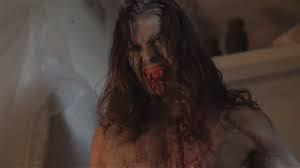
From Uncork'd Entertainment and running 85 minutes, Wrong Place Wrong Time hit home video via On-Demand and DVD yesterday, May 4 -- for purchase and/or rental.
Subscribe to:
Posts (Atom)


